
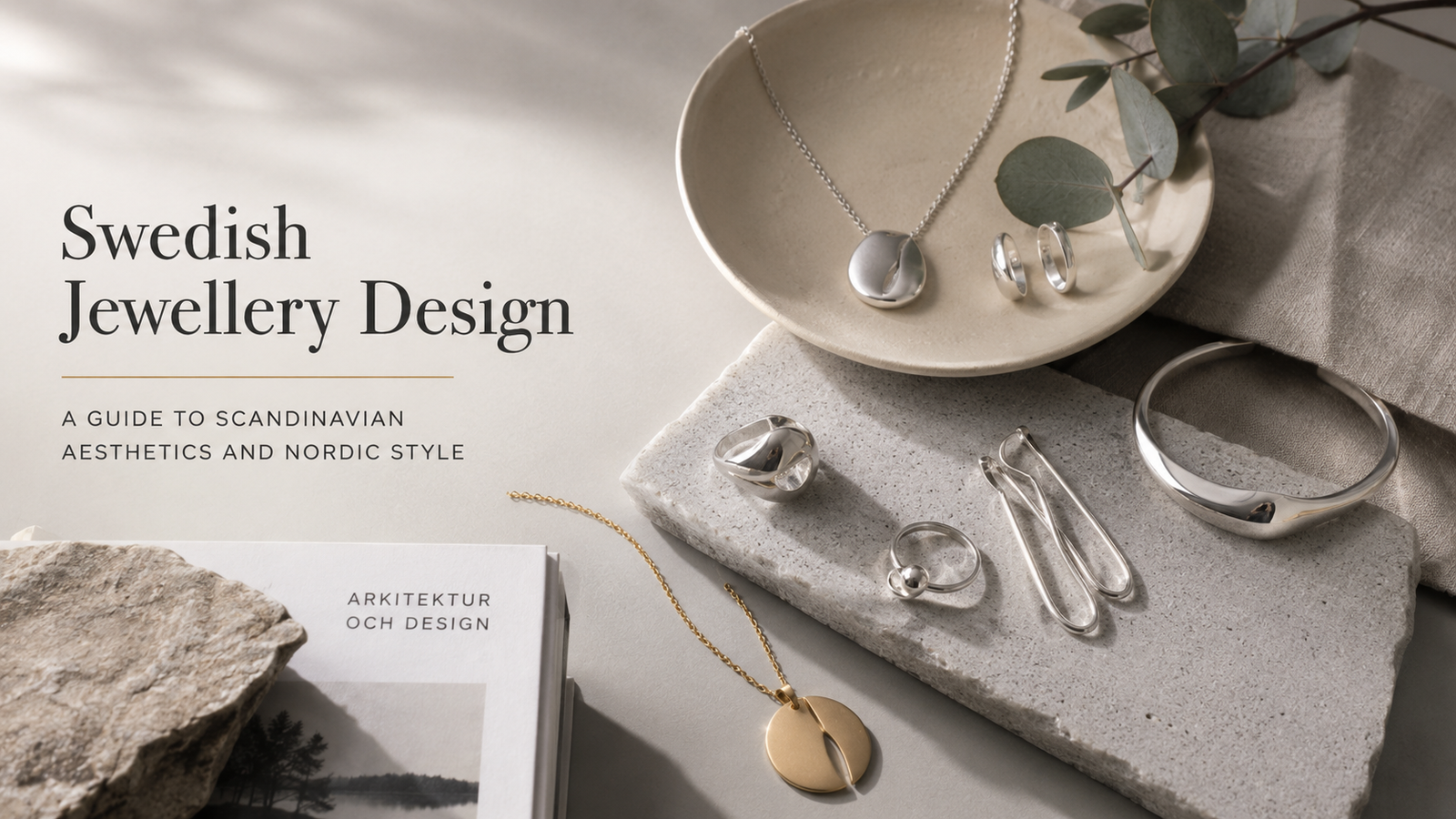
Swedish design has a global reputation that extends far beyond furniture and architecture. Scandinavian jewellery design — rooted in centuries of Nordic craft tradition and refined through the 20th century’s design revolution — is admired worldwide for its restraint, quality, and quiet confidence. Here is what makes it distinctive.
The Core Principles of Scandinavian Design
Scandinavian design philosophy, which emerged as a coherent movement in the 1950s, is built on a handful of interconnected principles: functionality, simplicity, craftsmanship, and democratic accessibility. Applied to jewellery, this means pieces that are beautiful without being ornate, well-made without being prohibitively expensive, and wearable across a wide range of occasions and lifestyles. Form follows function — but never at the expense of beauty.
The Connection to Nordic Nature
Swedish jewellery design draws heavily on the natural environment — the long winters and brief, luminous summers, the birch forests, the archipelago coastlines, the midnight sun. Materials like silver (historically abundant in Scandinavian trade), birch motifs, abstract water forms, and organic shapes reference landscape in an unforced way. The Swedish concept of naturlighet — naturalness, authenticity — runs through the design tradition as clearly in jewellery as in any other craft.
Viking Heritage in Modern Swedish Jewellery
The Viking age bequeathed Scandinavia an extraordinary jewellery heritage. Norse knotwork, runic symbols, animal interlace, and the characteristic oval brooches of the period remain a reference point for contemporary Swedish jewellers. The influence appears not as nostalgic reproduction but as a deeper aesthetic DNA — a preference for interlocking forms, for jewellery that tells a story, for silver over gold, for craft over ostentation.
Swedish Silver: A National Material
Silver has a special place in Swedish cultural and craft history. Sweden was a major silver trading hub during the Viking age, with silver flowing in from Central Asia, the Middle East, and the British Isles through extensive trading networks. Swedish silversmiths developed distinctive regional styles across different provinces, many of which survive in folk jewellery traditions — particularly in the form of brooches, belt fittings, and drinking vessels associated with traditional dress (folkdräkt).
Contemporary Swedish Jewellery Design
Sweden today is home to a vibrant contemporary jewellery scene centred on Stockholm, Gothenburg, and Malmö. Swedish art jewellery engages with conceptual and material experimentation — using unconventional materials, challenging the definition of wearable art, and engaging with social and ecological questions. At the accessible fashion end of the market, Swedish consumers consistently prioritise quality, longevity, and understated design — a reflection of the same values that define the broader design culture.
The Swedish Consumer and Jewellery
Swedish jewellery consumers are among the most design-literate in Europe. Research consistently shows Swedish buyers prioritising material quality, ethical production, and longevity over trend-chasing. The Swedish concept of lagom — roughly translated as “just the right amount” — translates directly into jewellery preferences: not too much, not too little, always appropriate, always considered. This is the aesthetic philosophy that shapes what we do at Zivanno.