
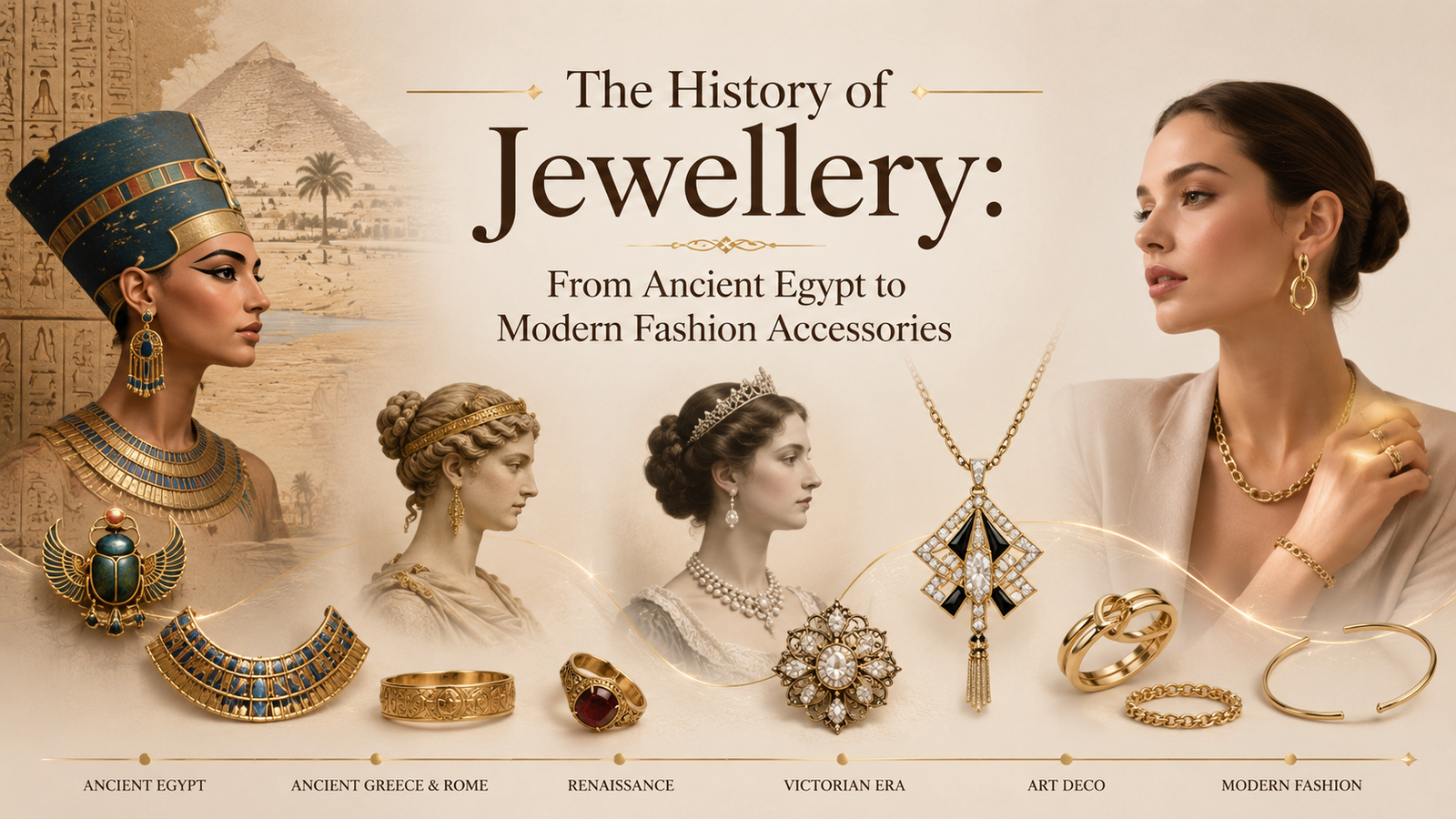
Jewellery is one of the oldest forms of human expression. Long before written language, before architecture, before organised religion — humans were adorning themselves with shells, bones, and stones. The history of jewellery is inseparable from the history of culture, wealth, identity, and love. Here is a journey through the ages.
The Very Beginning: 100,000 Years Ago
The oldest known jewellery dates to approximately 100,000 BCE — perforated Nassarius shell beads found in Blombos Cave, South Africa. These tiny shells, worn as a string, represent the earliest evidence of symbolic thinking in humans. Jewellery was not just decoration — it was a way of communicating identity, status, and belonging long before language could do the job.
Ancient Egypt: The Birth of Gold Jewellery (3,000 BCE)
No civilisation shaped jewellery culture more profoundly than ancient Egypt. The Egyptians had abundant access to gold from Nubian mines, and they used it lavishly. Broad collars, cuff bracelets, pectoral pendants, and earrings were worn by both men and women across social classes. Lapis lazuli, turquoise, carnelian, and faience (glazed ceramic) provided colour. Jewellery served religious and protective purposes as much as decorative ones — amulets shaped like scarab beetles, the Eye of Horus, and ankh symbols were believed to carry divine protection.
Ancient Greece and Rome: Status and Symbolism (800 BCE – 400 CE)
Greek jewellery introduced new techniques including granulation (tiny gold beads fused to surfaces) and filigree (delicate twisted wire work). Wreaths of gold leaves, snake-form bracelets, and cameo rings were popular. Romans elevated jewellery as a direct display of wealth and social rank. Sumptuary laws were even introduced at points to limit how much jewellery lower classes could wear — such was the status jewellery commanded.
The Viking Age: Scandinavian Silver (793 – 1066 CE)
Scandinavia has a rich and proud jewellery heritage. Viking jewellery was characterised by heavy silver and bronze pieces — twisted arm rings, oval brooches (used to fasten clothing), Thor’s hammer pendants, and elaborate bead necklaces. Silver was the prestige metal of the Norse world, obtained through trade and raid across Europe and beyond. The intricate knotwork and animal interlace patterns of Viking jewellery remain a major influence on Scandinavian design today.
The Renaissance and Baroque Periods: Jewellery as Art (1400–1750)
The Renaissance brought jewellery into the realm of high art. Goldsmiths were regarded as master artists — Benvenuto Cellini being the most famous. Enamelling, portrait miniatures set in lockets, and elaborate pendant jewels featuring mythological scenes defined the period. The Baroque era that followed embraced larger, more theatrical pieces set with diamonds, pearls, and coloured stones.
The Victorian Era: Sentiment and Mourning (1837–1901)
Queen Victoria’s reign transformed jewellery culture across Europe. Sentiment jewellery — lockets containing photographs or hair, rings engraved with secret messages, brooches spelling words with gemstone initials (acrostic jewellery) — became enormously popular. After Prince Albert’s death in 1861, mourning jewellery in jet, black glass, and onyx became widespread, with the Queen herself setting the trend.
Art Nouveau and Art Deco: Design Movements Take Over (1890–1940)
Art Nouveau (1890–1910) brought organic, flowing lines inspired by nature — dragonflies, flowers, and female figures crafted in enamel and mixed materials. René Lalique was the defining figure. Art Deco (1920–1940) was the complete opposite — geometric, symmetrical, and boldly graphic. Platinum, white diamonds, and contrasting black onyx defined the era’s cold elegance. Both movements continue to influence jewellery design today.
The 20th Century: Democratisation of Jewellery
The most significant shift of the 20th century was the democratisation of jewellery. Industrial manufacturing, new alloys, and synthetic stones made beautiful accessories available to everyone — not just the wealthy. The 1960s and 70s brought bold, experimental costume jewellery. The 80s brought maximalism. The 90s brought minimalism. And the 2000s brought the internet — connecting consumers directly to designers and makers worldwide.
Today: Fashion Accessories for Everyone
Modern jewellery accessories sit at the intersection of craft, design, and self-expression. The global fashion accessories market is valued at over €300 billion. Trends move faster than ever, driven by social media. But the fundamental human desire that drove those first shell beads 100,000 years ago remains unchanged — the desire to adorn, to signal, to express who we are. That is what jewellery has always been for.